Showing posts with label unconventional training tools. Show all posts

Wednesday, December 22, 2021

Getting Medieval with Strength Training!

Children of the Sun

So I recently came across this cool video on YouTube of Medieval Strength & Conditioning exercises.

https://www.youtube.com/watch?v=mOxWqdydnD4


This is a fun topic. The creator of the video is a PhD student named Maciej Talaga and is working on “an embodied study of the martial system of Hs3227a and its corresponding physical-cultural context” for their dissertation. I, of course, am interested in the part that I italicized. Altho that may win the prize for best PhD research ever.


The video, and underlying dissertation work, is based on a variety of historical sources, but which are nonetheless limited. Talaga describes them further in a Patreon post. 


I see two basic ways of looking at this information. 


  1. Choosing to do strength training in a historical style for the purposes of better understanding and living one’s Historical Fencing training. This is essentially a living history approach. This is cool. And if that’s what motivates you to exercise (more) then that is awesome. 

  2. As inspiration for your personal training program using some mix of old and modern equipment or entirely modern equipment. 


I’m going to focus on option two here because it falls within my wheelhouse.


I work professionally as a Physical Therapist and Strength Coach. If you are interested in my services you can contact me at: hirsh.sm@gmail.com


If you like this blog post you can support me by hitting the Ko-Fi button on the right.

So Let’s Talk About the Exercises Shown

Stretching and Calisthenics

Talaga starts with some basic stretching and calisthenics. My understanding of the history of exercise is that this didn’t start to become a specific organized practice until the 19th century and that it started in Britain. Talaga does not detail it in the accompanying blog post and notes that it was recommended by a modern exercise professional related to some pre-existing injuries.


A good warm-up is, of course, useful, but there’s no particular magic to any specific warm-up and there are lots of right ways to do it. 

Wrestling drill

During the warm-up portion of the video there is a picture-in-picture of what appears to me to be a modern looking grappling style of drill/exercise. Also not referenced and just as good as other warm-up options.

Windmill exercise

No historical source listed but still a good exercise for developing shoulder stability and strength throughout range of motion. Which is particularly good for historical fencers.

Headstand

Categorized as activation by Talaga. This may be a terminology and/or language thing because I’m not sure what they're getting at. BUT it certainly is a historically attested exercise and there’s no reason not to do it.

Staggered and Hockey Deadlift

The rationale given for this one is questionable to me. There are historical images that look like these two exercises but Talaga concludes that they are actually in preparation for doing throwing motions. This is plausible to me. However, based on watching old-style throwing sports i.e. Highland games, I don’t think this part is a key element of the throwing itself. So I would hesitate to conclude that these were done as exercises themselves in period.


That being said I think they are good exercises and worth including on their own. They also help with equipment limitations since getting a really heavy deadlift is hard with rocks.

RDL

As the weight increased with the unilateral deadlifts Talaga transitioned to a Romanian style or straight leg deadlift. He calls it a regular deadlift in his write up but that’s a minor distinction here. 
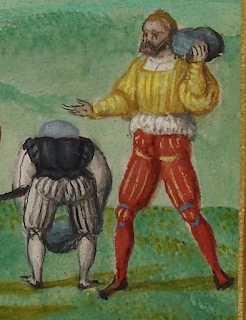

Straight leg deadlift on the left, context suggests set-up for stone throw

Still a good exercise choice.

Single-arm Press

Very good exercise. Sport specific by being upright and unilateral. This is a routine thing for me to include with my clients currently.
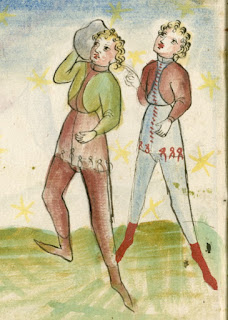
Positioned for a single arm press

Zercher Squat

Best squat you can do with the equipment. But it illustrates one of the key limitations of using the period style of equipment - weight progression is limited by the arms, so the legs just don’t get as much as they could.


A modern front squat permits maxing out the legs instead of the arms being the limiter.

Deadlift

Eventually, while doing the Zercher squats they reach a point where it’s hard to keep the weight off the ground and they switch to doing an Atlas stone style deadlift. Again, good exercise selection. Equipment limitations are noteworthy tho.

Pullup

Good exercise of course. But also not accessible for someone who doesn’t start with the strength-to-weight ratio necessary to do a pullup. Period equipment would make this a hard problem to solve, since the only strategy would be to do negatives. 


Inverted rows are within the ability of the time, but hard to progress just by finding branches of the correct height.


This then is an area that makes modern equipment shine. Substitute/combine this with DB and BB rows and you’ve got your pulling motions covered.

Javelin Throwing

I LOVE EVERYTHING ABOUT THIS


I have wanted to incorporate javelin throwing into my regime ever since I learned it was a period exercise many years ago. But it’s hard to do while living in a city, in an apartment with no yard. Sigh.


But I get a similar stimulus from doing medicine ball throws. Light weight, high velocity, can be adjusted for movement specificity. 

Stone Throwing

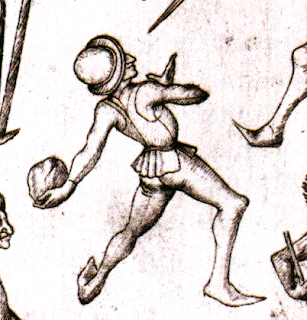
Also great! Same trouble as the javelin tho, but easier to overcome. I throw sandbells for this instead.

Clearly about to throw the stone

 
Long/Broad Jump
Talaga calls this a long jump. English language usage would call it a broad jump - the long jump involves a running start. Also a great exercise. Normal thing for me to include in my clients’ programs. Altho I prefer the box jump because it’s easier on the knees and allows for clear progression and tracking.

What’s Missing?

Really, not much besides the pulling exercise limitation. 


We have all the basic categories covered: 

  • Lifting

  • Squatting

  • Unilateral leg exercises

  • Pushing

  • Pulling

  • Anti-rotation/oblique abdominal exercises

  • Explosive exercises

Those are the categories I look to include in each exercise plan. 

Conclusion

The other sort of limitation with this equipment is limited options for progression. And I suspect that the idea of a clear progression scheme may be missing from historical sources as well. At least based on the written sources that I am familiar with - that some folks in the era had an oral tradition of a progression scheme is of course possible. 


I think this was cool PhD work, a cool idea and an informative video. It’s an interesting way to think about one’s modern training program as well. Have fun with this.


Monday, November 2, 2015

Help, my shoulders are too high!


We see this plenty in martial arts, fencing and, well, normal life. People who keep their shoulders up too high, kind of bunched up or tense, but all the time. Or maybe just while they are training. For training it's most common in new fencers. Recently somebody asked about it on the HEMA Alliance Facebook page and here's my long response.

Let me get technical for a moment. I'm talking about excessive tension in the upper traps that elevates the shoulder joints. If you're actually looking at something else, then this won't help.

I'm going to address the common advice and suggestions as well as my own thoughts.

Stretching

A lot of people will suggest stretching for something like this. But stretching is seldom the answer, though it can be part of it. Here's why:

  1. Go stand in front of the mirror.
  2. Depress your shoulders, that is shove them towards the ground - see the third picture
  3. If you can get them to normal posture (the second picture) then muscle length isn't the problem.

Hunched posture - the problem we are correcting
Normal posture - the objective
Depressed posture - should be able to get the shoulders this low
Stretching solves problems when the muscle is short. And such is seldom the case for this particular problem.

If stretching feels good then that's good and go ahead and do it.

If stretching helps relieve tension then that's good and go ahead and do it.

So, by all means, include stretching if you like, but also know that it won't solve the problem.

Yoga


Yoga for what?

If it's stress reduction then go for it. Lots of people are stressed and any kind of meditation activity that they find stress relieving is a good thing. Stress can be the primary contributor to the elevated shoulder problem. You've probably heard, or are, somebody who says, "I carry my stress in my shoulders".

Finding a good way to reduce your stress is quite important in life. But it's outside the scope of my blog.

If the yoga suggestion is based on the idea that certain of the yoga postures will cure the problem then I want to know which ones. All too often there is just a generic suggestion for yoga as if the whole of it is some cure-all, without looking at the specifics of individual yoga postures.

A quick google search on yoga poses for shoulder problems came up with a whopping zero poses useful to this problem. This does not mean that they don't exist. But it illustrates that a simple suggestion of yoga in general is not sufficient.

Strengthen the Upper Back


Well, we might expect me to be all over a strength training solution!

But the upper back strength isn't the solution to this problem. It's probably the cause, or at least an accomplice.

The upper back muscles are primarily the trapezius and rhomboids. You also have the top part of the spinal extensors, but they don't attach to the shoulder blade or joint.

The traps are a big muscle group that primarily elevates and upwardly rotates the scapula, so that's a possible culprit. And by possible I mean almost certainly it. Though with a possible contribution from the levator scapulae.

So strengthening the already overactive or tight muscles won't help!

The rhomboids downwardly rotate and retract the scapula, so we can rule them out. Strengthening the rhomboids might actually help us, but the upper traps are much bigger, and so we can't win that tug of war with just reverse flys.

Strengthen Other Things


Farmer's Carries - I love farmer's carries. I just spent good money buying equipment to do heavier carries. But that's an exercise where gravity pulls the shoulder down, so they won't help keep the shoulders down in other actions.

Indian Clubs - I'm not a big fan of these, because there is nothing they do particularly well, they're really just a conditioning tool. And they don't have a way to work the muscles to pull down the shoulders. Whether or not they help is entirely dependent on how good you keep your posture while using them. And that's true of a lot of options. So it's really independent of a solution.

But it does indicate something useful. Being mindful of posture during all strength training, especially standing exercises, will help.

Bodyweight exercises - Which ones? Most of them are simply not relevant to the problem. The only relevant one, really, is pull-ups. And so if you are capable of pull-ups then they should benefit this particular problem. But pull-ups are really hard for a lot of people, so they are usually not a good general purpose suggestion.

Posture

We are moving progressively closer to the best understanding and solution to the problem with this. Better posture is better. Work to increase the amount of time in good posture and your awareness of your posture - in every part of your life. In particular here is getting the shoulders back and down. If you have a desk job this is a challenge. And addressing that challenge is it's own big topic.

There is also your posture when you are on-guard. When you are in guards with the arms and sword above the level of the shoulder it's natural to also hunch up the shoulders. But you don't have to do that. You can get your arms overhead and keep your shoulders down.

Shoulders hunched high guard position
Shoulder neutral high guard position
You may also have your shoulders elevated in a lot of your guards. In which case switching to pflug or Fiore won't help. Sean Hayes talks about it in this video.


One of the cues for getting your scapula into the right position for overhead guards is to think about sticking your shoulder blade into your back pocket.

* Side benefit of this: it's healthier for your rotator cuff!


Tension


Are you tense while you are training? If you're new you probably are. I see this problem an awful lot. And it's understandable. When you start you don't understand any of it, it's all new. There's a lot to concentrate on. And many people naturally hunch up their shoulders in this situation.

I tell people to relax. I then I tell them that relaxing will take a while. You have to get better at the actions to be able to think about relaxing while doing them. When it's new you have too many things to think about to be able to also think about relaxing.

I'm really relaxed while doing the things that I've been doing with a sword for years. It's easy for me at that point. I'm sure a video camera would show more tension in the brand new stuff. But I've also got, at this point, 17 years of martial arts training, so I've got a habit of being relaxed while doing this stuff. And that took time i.e. don't expect a quick fix. This is a long-term project.

The take-away is spend more training time on the stuff that is not super challenging. That's doesn't mean spend it all on the easy stuff. But spend most of your time on the actions that you get mostly right, most of the time. This is actually my general advice to all my students, just based on learning theory. The advanced stuff, that may be stressing you out, should be practiced with a coach who can provide feedback.

Good Strength Training


Of course I'm going to conclude that strength training has a role to play in addressing this! But it may be a much smaller role than the above about stress and tension, depending on the person.

There is a reflex in the body to keep the muscles safe by turning down the activation of opposing muscle groups when activating a particular muscle. So an overactive upper trap is turning down the activity of the opposing muscles that pull the shoulders down.

And so we can use that to our advantage. As we train up the muscles that pull the shoulders down we increase their resting tone. This will have the effect of turning down the resting tone in the opposing muscles. And thereby reducing the tendency to hunch up those shoulders

What exercises pull down the shoulders? Lat pulldowns. And pull-ups.

You may think of these as primarily latissimus dorsi exercises, and they are. The lats are a big muscle that pulls the shoulders down - amongst other actions. Your rhomboids will also be helping with these exercises. As well as the lower traps.

And that's pretty much all the muscles that pull your shoulders down. So make sure you are including vertical pulling exercises in your complete strength training program.


Does it Hurt?


If yes, then see a medical professional. I am not a doctor.

If you aren't sure yet then ask following questions:
  1. Has it hurt for more than 2 weeks? If so, see a doctor.
  2. Does it hurt even when you are not training? If so, see a doctor.
  3. Does the pain interfere with any other part of your life? If so, see a doctor.

Specifically, see a physical therapist or orthopedist.

Conclusion


In my experience, the most common cause of this is being new. And that can go on for a very long time. The next most common is generally carrying tension in your shoulders. As such, strengthening, stretching and other exercises have only a small role to play in this type of problem.

However, it's not a self-correcting problem. If you do this when you are new then you will do this always. That's what coaches are for, to spot your errors and remind you to fix them.