Showing posts with label strength. Show all posts

Wednesday, May 11, 2022

Single Sword Strengthening

Training with a single-handed sword can present some particular challenges for your wrist, forearm, elbow and shoulder. Newer fencers especially may find that their training time and capacity are limited by fatigue or discomfort. And ongoing or recurring complaints of fatigue or discomfort are ordinary. Below are exercises specifically for addressing this issue to improve training capacity, injury resistance and performance. 


I work professionally as an independent physical therapist and strength coach. If you are interested in my services you can email me at: hirsch.sm@gmail.com. Or, if you just want to support my blog you can buy me a KoFi.


This information is specifically for healthy individuals. If you already have pain or injury in the arm you should first seek evaluation from a physical therapist. 


Equipment

These exercises are best done with some basic equipment. 


First is just a simple stick. I recommend 3/4” rattan or hardwood dowel, ideally 39” long. This is a standard length for single-sticks and readily available from my friends at Purpleheart. (No promotional consideration - I like them and their products). But you can also get a hardwood dowel from a home improvement store.


Next is some small dumbbells or hand weights. Most folks can start at 2# tho smaller folks may need to start at 1#. 1 and 2 pounds can usually be done with cans or water bottles instead of buying anything. 1 pound = 16 oz of water or soup = 473 mL. 


Higher weights are better achieved with purpose built equipment to ensure it is convenient and safe to use. These weights are usually available for about $2-3 per pound.


For the shoulder exercises - and just because it is useful for a wide variety of exercises - an adjustable dumbbell set is convenient and a good bang for your buck equipment. 

Programming

Stick Wiggle

This exercise should be done for sets of 10-20, with a focus on speed and not on increasing the number of repetitions. Because this is a speed exercise increasing the weight of stick or switching to your sword or other equipment does not help.

Stick Rotations

Start this exercise with the same singlestick. When you are ready to progress (see below) a saber is likely to be a reasonable step-up tho heavier sabers are a bigger jump than appropriate. As strength improves a broadsword, arming sword or side sword become appropriate. Yes these are generalizations based on sword categories and I know that there is substantial variation within each category. If you need something in between a singlestick and your sword you can use a longer or thicker stick both of which are readily available at a typical home improvement sword.


Longer term this exercise can be phased out and increasing weight beyond your sword is usually not necessary. 

Scaption

Most folks can start this exercise at 5 pounds and adjust initial repetitions appropriately. Progression may be more awkward depending on what specific weights or adjustability you have available. 

Wrist Flexion & Extension

Start at 2 pounds and work your way up based on difficulty. Some folks will progress up to 5 pounds or more quite quickly and others will need to increase more slowly. Longer term you are likely going to be able to use more weight for flexion than extension.

Workout Timing

Between this training and your technical training you should be aiming for 4 to 6 days per week with this workout two or three times. The more technical training time the less of this workout you should do. 


These workouts should not be done on consecutive days and you should avoid doing this workout shortly before technical training. 

Repetitions and Sets

Progress thru the following sequence of number of reps per exercise.

  • 8

  • 10

  • 12

  • 15

  • 18 - only necessary for large jumps in next weight size up. 


Do the number of reps in a workout for one workout. Next workout try to work up to the next target number. If you can hit the target for all sets then go up in reps next workout. If you cannot then stay at that number of reps for the next workout. When you have hit 15 or 18 reps in a workout then go up in weight and drop the number of reps back down to 8 or 10. 


For instance: if I have 3 and 5 pound weights for wrist flexion and extension then I will progress from 8 thru 18 reps over some number of weeks before I jump from three pounds to five pounds. As a percentage that is a 67% jump. At 5 pounds I will start at 8 reps again.


If instead I have a 4 pound weight I would increase the weight at 15 reps. I may only need to drop down to 10 reps since the jump from 4 to 5 pounds is only 25%.


Number of repetitions and weight should be tracked individually for each exercise. If you would find an app a useful way to do that then I recommend JeFit. Steady and identical progress in all exercises is not typical. 


Each exercise should be done for at least 2 sets. Between sets you should either rest 30 seconds or cycle thru different exercises if you want to use the time more efficiently. If you feel like you could do two or three sets without a break then you should increase the weight instead.


I usually do three sets. More sets will help more with endurance but there are diminishing returns. Having lower (2 sets) and higher (3-4 sets) volume days may also be reasonable depending on the rest of your training schedule. 

Wrist Flexibility

If you think that you have a limitation in wrist flexibility please watch this video first.

Basic Strengthening

There are clear advantages in a basic and complete strengthening program. I discuss that here. With a complete program then the exercises can simply serve as a spot supplement as needed. 

Conclusion

A specific or complete strength and conditioning program will improve training capacity, injury resistance and performance.



Wednesday, December 22, 2021

Getting Medieval with Strength Training!

Children of the Sun

So I recently came across this cool video on YouTube of Medieval Strength & Conditioning exercises.

https://www.youtube.com/watch?v=mOxWqdydnD4


This is a fun topic. The creator of the video is a PhD student named Maciej Talaga and is working on “an embodied study of the martial system of Hs3227a and its corresponding physical-cultural context” for their dissertation. I, of course, am interested in the part that I italicized. Altho that may win the prize for best PhD research ever.


The video, and underlying dissertation work, is based on a variety of historical sources, but which are nonetheless limited. Talaga describes them further in a Patreon post. 


I see two basic ways of looking at this information. 


  1. Choosing to do strength training in a historical style for the purposes of better understanding and living one’s Historical Fencing training. This is essentially a living history approach. This is cool. And if that’s what motivates you to exercise (more) then that is awesome. 

  2. As inspiration for your personal training program using some mix of old and modern equipment or entirely modern equipment. 


I’m going to focus on option two here because it falls within my wheelhouse.


I work professionally as a Physical Therapist and Strength Coach. If you are interested in my services you can contact me at: hirsh.sm@gmail.com


If you like this blog post you can support me by hitting the Ko-Fi button on the right.

So Let’s Talk About the Exercises Shown

Stretching and Calisthenics

Talaga starts with some basic stretching and calisthenics. My understanding of the history of exercise is that this didn’t start to become a specific organized practice until the 19th century and that it started in Britain. Talaga does not detail it in the accompanying blog post and notes that it was recommended by a modern exercise professional related to some pre-existing injuries.


A good warm-up is, of course, useful, but there’s no particular magic to any specific warm-up and there are lots of right ways to do it. 

Wrestling drill

During the warm-up portion of the video there is a picture-in-picture of what appears to me to be a modern looking grappling style of drill/exercise. Also not referenced and just as good as other warm-up options.

Windmill exercise

No historical source listed but still a good exercise for developing shoulder stability and strength throughout range of motion. Which is particularly good for historical fencers.

Headstand

Categorized as activation by Talaga. This may be a terminology and/or language thing because I’m not sure what they're getting at. BUT it certainly is a historically attested exercise and there’s no reason not to do it.

Staggered and Hockey Deadlift

The rationale given for this one is questionable to me. There are historical images that look like these two exercises but Talaga concludes that they are actually in preparation for doing throwing motions. This is plausible to me. However, based on watching old-style throwing sports i.e. Highland games, I don’t think this part is a key element of the throwing itself. So I would hesitate to conclude that these were done as exercises themselves in period.


That being said I think they are good exercises and worth including on their own. They also help with equipment limitations since getting a really heavy deadlift is hard with rocks.

RDL

As the weight increased with the unilateral deadlifts Talaga transitioned to a Romanian style or straight leg deadlift. He calls it a regular deadlift in his write up but that’s a minor distinction here. 


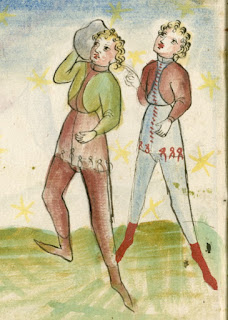
Straight leg deadlift on the left, context suggests set-up for stone throw

Still a good exercise choice.

Single-arm Press

Very good exercise. Sport specific by being upright and unilateral. This is a routine thing for me to include with my clients currently.

Positioned for a single arm press

Zercher Squat

Best squat you can do with the equipment. But it illustrates one of the key limitations of using the period style of equipment - weight progression is limited by the arms, so the legs just don’t get as much as they could.


A modern front squat permits maxing out the legs instead of the arms being the limiter.

Deadlift

Eventually, while doing the Zercher squats they reach a point where it’s hard to keep the weight off the ground and they switch to doing an Atlas stone style deadlift. Again, good exercise selection. Equipment limitations are noteworthy tho.

Pullup

Good exercise of course. But also not accessible for someone who doesn’t start with the strength-to-weight ratio necessary to do a pullup. Period equipment would make this a hard problem to solve, since the only strategy would be to do negatives. 


Inverted rows are within the ability of the time, but hard to progress just by finding branches of the correct height.


This then is an area that makes modern equipment shine. Substitute/combine this with DB and BB rows and you’ve got your pulling motions covered.

Javelin Throwing

I LOVE EVERYTHING ABOUT THIS


I have wanted to incorporate javelin throwing into my regime ever since I learned it was a period exercise many years ago. But it’s hard to do while living in a city, in an apartment with no yard. Sigh.


But I get a similar stimulus from doing medicine ball throws. Light weight, high velocity, can be adjusted for movement specificity. 

Stone Throwing

Also great! Same trouble as the javelin tho, but easier to overcome. I throw sandbells for this instead.

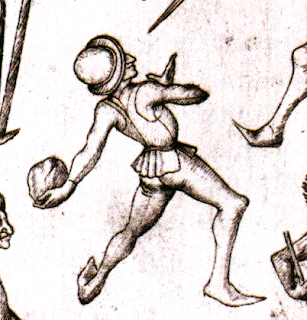
Clearly about to throw the stone

 
Long/Broad Jump

Talaga calls this a long jump. English language usage would call it a broad jump - the long jump involves a running start. Also a great exercise. Normal thing for me to include in my clients’ programs. Altho I prefer the box jump because it’s easier on the knees and allows for clear progression and tracking.

What’s Missing?

Really, not much besides the pulling exercise limitation. 


We have all the basic categories covered: 

  • Lifting

  • Squatting

  • Unilateral leg exercises

  • Pushing

  • Pulling

  • Anti-rotation/oblique abdominal exercises

  • Explosive exercises

Those are the categories I look to include in each exercise plan. 

Conclusion

The other sort of limitation with this equipment is limited options for progression. And I suspect that the idea of a clear progression scheme may be missing from historical sources as well. At least based on the written sources that I am familiar with - that some folks in the era had an oral tradition of a progression scheme is of course possible. 


I think this was cool PhD work, a cool idea and an informative video. It’s an interesting way to think about one’s modern training program as well. Have fun with this.


Friday, January 22, 2016

An Ideal Workout Scheme

I've got some significant advantages this year. I'm self-employed, at a gym. So I can set my own schedule, which means I get a full night's sleep every night, and I'm at the gym almost every day. As such I can set myself up with an ideal workout program.

Odds are that none of my readers can implement a program like this. That's fine. By explaining what ideal is we can look at it as a thought experiment and also take the achievable parts and implement them where doable.

What's Ideal?


First we need to establish what ideal we are looking for since ideal is necessarily based on objectives. The plan I'm about to describe is not ideal for a marathon runner or a tennis player. The objective I wanted to work on is maximum strength as a foundation for developing sport specific characteristics. As such the plan is a modified powerlifting routine.

Powerlifting is competition in Deadlift, Squat and Bench Press. Our basic, core movements with a program geared towards the highest strength possible - that is the highest 1RM. I also wanted to include the Olympic lifts because, as a(n actual) power athlete, I need those characteristics as well. (Powerlifting is not actually maximum power, the Olympic lifts do that. And competition in the Oly lifts is called weightlifting, even though it's not actually the most weight - go figure.)

The only real omission in powerlifting is a dynamic back exercise, since the deadlift is basically isometric for the spinal erectors and upper back. There are also overhead movements missing, though the bench does work those muscles and the overhead lifts from the Oly lifts cover that reasonably well. Therefore, my plan added these components in.

The plan


The plan's outline comes from this blog post by Greg Robbins over at Eric Cressey's blog.
  • Monday - Squat High
  • Tuesday - Deadlift Low
  • Wednesday - Bench High
  • Thursday - Squat Low
  • Friday - Deadlift High
  • Saturday - Bench Low
The days are divided up by our core exercises, so that we get two days of each, which is a lot of training volume. More volume gets us technical training as well as gains in weight moved. This plan keeps the same muscle group from being used maximally two days in a row e.g. my back is relevant for the squat but not maximally like it is for the deadlift.

There are two days between each day of a core exercise, which is sufficient recovery time.

There are no two days in a row of High intensity, thereby allowing me to recover in a whole body sense and not just in a muscle specific sense.

The heavy days have a warm-up portion for the main exercise as well as the maximal lifts. These are submax and help me dial in my technique as well as utilizing post-activation potentiation. The linked article describes this component.


CategoryMondayTuesdayWednesdayThursdayFridaySaturday

Squat HighDL LowBench HighSquat LowDL HighBench Mid
Warm-up

Planks1-Leg StabilityTurkish PartsPlanks
PrepBox JumpTurkish Get-upHeavy ThrowSingle Leg BoxBroad JumpYoga Push-up
OlyCleanSnatch HighLandmine SnatchClean and JerkSnatch LowLandmine Jerk
Main Warm-upSquat Warm-up
Bench Warm-up
DL Warm-upIncline Bench
MainSquat HighDeadlift LowBench HighSquat LowDeadlift HighBench Mid
AccessoryStep-up
1-arm BenchSplit Squat1-arm RowLat Pulldown

Suitcase CarryRDLWrist CircuitOH SquatSLDLPallof
Prehab
YTI - ScapulaExt. Rot.

Wrist Ext/Flex
* Squats are Front Squats - of course.

What else is going on


All of this is in addition to the regular training that I undertake. So there is the conditioning at the beginning of each of my classes, which includes some velocity-power work and more of the trunk stability components.

Plus, of course, there is all my technical training with the sword. Altogether I was getting about 12-14 hours a week of intense training. Plus the walking to and from work (a kilometer each way) and to any other place since I don't own a car. And going out dancing periodically. It's a lot.

Actually, it was too much to start with.

The down side


I overtrained. I felt like I'd done too much lifting to get technical training in as well, so my swordwork was decreasing. I recognized it fairly early and made adjustments. I removed some exercises (which is already reflected above). And I reduced the volume on others. I hit a sustainable point though. It just took some trial and error.

Applying it to your own case


Well, now how does this apply to you? Many ideas are possible. Here are a few ways:
  • First you can arrange your schedule around the core lifts instead of body parts or some such. You do Deadlift, Squat and Bench every time for a 3-day schedule but each day there is a most important, most intense lift.
  • You can run a 4-day program with Deadlift and Bench one day, and Squat and Pullup another. It's still more.
  • Perhaps this just motivates you to do a Powerlifting program for the early phases of your periodization.
  • Just put more sets in for the core lifts, at submax intensities, to get the technical training time under the bar. 
There are lots of other possibilities and I'd love to hear your thoughts, too.

Conclusion


I encourage you to put a lot of thought into what you could be doing to maximize your training. 

Monday, December 7, 2015

Our Longpoint Periodization Scheme

Longpoint 2016 Training has begun. There are lots of components to this training regime on the technical skills side as well but here, obviously, I'm going to focus on our strength training program.

With a clear end date for the program it is possible for us have a clear outline. We are looking to peak our training in mid-July next year. The program started at the beginning of November. We've got about 9 months to go.

I've broken this down into 5 phases. The first four are two months each and the last is the remaining weeks before the event.

The periodization is a simple linear progression. We start at (relatively) low intensities and high volume of training and progress to higher intensities while cutting back on volume.

Each phase has a three day a week workout plan:
  • The first day is the heavy day, with Clean, Deadlift and Bench Pres, plus a small number of accessory exercises covering the lunge, pull and anti-rotation movement patterns.
  • The second day is the lighter day, with Jerk and Squat as the big lifts and more of the accessory type exercises covering the lunge, pull, lift and anti-rotation movements.
  • The third day is optional and consists entirely of accessory style exercises. It is intended to be done at home or at a typical commercial gym and so focuses on dumbbell exercises.
Each month has a low-intensity, sub-max week for more complete recovery. Otherwise the numbers listed below are all Repetition Maximums (RM).

Unless otherwise stated each exercise is done for 3 sets.

Phase I

Heavy day
  1. Power - 5 (Clean and Box jumps)
  2. Primary - 8
  3. Accessory - 10
Light day
  1. Power - 5 (DB Jerk and Medball throws)
  2. Primary - 12
  3. Accessory - 12 
Power exercises are pairs of Olympic lifts and another simpler power exercise.
Main exercises are paired with a complementary exercise.
Accessory exercises are circuits of three exercises.

Phase II

Heavy day
  1. Power - 5
  2. Primary - 8
  3. Accessory - 10
Light day
  1. Power - 5 (Barbell Jerk)
  2. Primary - 12
  3. Accessory - 12 
Power exercises are paired with fewer sets of the alternate exercise as their load goes up.

Phase III

Heavy day
  1. Power - 5
  2. Primary -6
  3. Accessory -8
Light day
  1. Power - 5
  2. Primary -10
  3. Accessory - 12 
Power exercises are no longer paired with an alternate exercise. The load should be fairly high at this point and the athletes sufficiently experienced with the exercises to get true max effort sets.
Main exercises are no longer paired with a complementary exercise.
Accessory exercises are now only pairs of exercises. Specificity increases with lateral leg exercises and upper body exercises with torso rotation.
A small circuit of lower intensity exercises fills out the program. Examples include: carries, single-leg squats, planks & variations and band exercises.

Phase IV

Heavy day
  1. Power - 5/4/4
  2. Primary - 5 Complex
  3. Accessory -8
Light day
  1. Power - 5
  2. Primary -8
  3. Accessory - 10
Main exercises are now either complex sets or with resistance bands added. 
Accessory exercises dialed back to just two sets.

Phase V

Heavy day
  1. Power - 5/4/3
  2. Primary - 5 Complex
  3. Accessory - 8
Light day
  1. Power - 5
  2. Primary - 6
  3. Accessory - 8
Accessory exercises will increase in specificity while decreasing in load.

Rep Max Testing 

Rep Max testing is done at the end of each phase to recalibrate numbers for the main exercises. At the end of Phase I it will be just 3-5RM testing since they have not been moving high intensity loads for this phase.

For the remainder of the program 1RM testing will be used.

Conclusion


This is a simple linear periodization scheme appropriate for beginning and intermediate lifters. Even for advanced lifters this type of program works well when there is a single most important event on the calendar. Other, more complex, schemes are more appropriate for a fuller competition schedule and advanced athletes.

Thursday, December 3, 2015

More of What Is Strength?

Well, I'm glad you asked? Actually, Alex Bourdas asked this in his most recent post over on my favorite HEMA blog: Encased In Steel. My post is intended to act as a commentary on that post - to add details and clarity. Alex's post is good, mine is not a criticism, his is shorter and more readable.

As Alex starts off with defining strength. Strength is a term that gets used a lot in an imprecise way.

To a exercise professional, strength is maximal force production. In addition to the sources that Alex provides we see the same from the NSCA and ACSM research. It's the same in my Doctorate in Physical Therapy program.

Force = mass*acceleration. So increasing force production means increasing acceleration of the body and weapon.

On the other hand, endurance is defined as the amount of time that an amount of force can be produced. In this case increased endurance means more repetitions, not more force in each repetition. There is a clear inverse relationship between power and duration of force production. Therefore strength and endurance are at opposite ends of a spectrum of force production.

In exercise science intensity is defined as a percentage of maximal force production. This is different from the colloquial and dictionary usage of intensity. So a Crossfit workout that leaves you puking may have been intense, but not in the technical use of the word, since it was high rep training. A 100m sprint may not feel as draining as a marathon, but the sprint was more intense.

So, a single exercise intensity cannot increase both endurance and strength.

Does that mean that any claim that an exercise program increases both endurance and strength bogus? Well, only mostly. If you take a sedentary person and increase their physical activity - by any means - then that person will gain both strength and endurance. But only for the first 8-12 weeks. After that, one of the characteristics is going to plateau based on the program's intensity.

And this is where we get the personal testimonials of a program that does everything. And the research backs up this fact that any exercise will improve most things in a sedentary person. So, a personal trainer, or a person selling a book, can even claim to be supported by the science. But only by cherry-picking the research instead of looking at the entire body of research.

How Intense is Strength?


I defined above that strength gains are made at a given intensity. That intensity is 67% and higher (1, 2).

And this is where a clarification of something Alex said is really necessary. The repetition range he quotes is 20RM and lower. While the sources above give 12RM and lower.

Note though that the IOC source that Alex provides also specifies the duration of those sets - 30 seconds or less. I can do 20 reps in 30 seconds only by moving the weight faster, which requires more force. Or I can do reps that take 3-4 seconds each and do only 8-10 reps. That 3-4 seconds is 1-2 seconds down, pause at the bottom, 1 second up and then pause at the top.

Twenty slow controlled reps is not strength training, it's muscular endurance. But 20 medicine ball throws in 30 seconds is strength and power.

Most strength training is done at intensities of 12RM and lower. Significant strength gains - and significant power gains - occur at intensities higher than 8RM. As such strength training should focus on those numbers.

Strength Isn't the Only Thing


Of course it isn't. And I'm certainly not saying that you should win a fight simply by being stronger than the other guy.

But more relevantly, strength is not the only characteristic relevant to training. Increasing endurance allows a person put in more training time. And that's good for us. Therefore a balance should be found between strength and endurance training. We can do that three ways:
  1. Remember that strength increases will also increase muscular and cardiovascular endurance. Not as effectively as dedicated endurance and cardio work, but sometimes it's all that's needed. Note though that this is not a two way street. Endurance and cardio do very little for strength.
  2. Include lower intensity exercises. Perform the accessory exercises of the program at a lower intensity to help cover muscular endurance needs. These are the single leg or arm exercises or the trunk/core specific exercises.
  3. Periodization. Start the program at lower intensities and gradually increase the intensity. Don't just increase the weight as you get stronger. Increase the weight enough to decrease the number of reps possible. Aim to have the highest strength and power portions in time for a particular important event, date or competition. However, periodization is it's own topic for a much longer post. 

Conclusion


Train smart and know what strength is. And how it is different from endurance and cardiovascular conditioning.

Thursday, September 10, 2015

Forearm, Wrist and Grip Strengthening

One of the biggest challenges for many new students of the sword and other combat sports is forearm/wrist strength. This is especially the case for single-handed sword work, smaller people and those with limited upper-body strength. There are two areas of problem that emerge from limitations in forearm strength: 1) the risk of injury is higher, both for repetitive stress and sudden injuries; 2) the student will be limited in the number of repetitions of an action they can do, especially those they can do with good quality - which limits how much training they can do.

The first and most basic strategy for creating a foundation of forearm strength is going to be basic lifts. In subsequent posts I'll discuss ways to focus, refine and increase the specificity of the program.

Lifts, Pulls and Pushes

Of our basic categories of exercises the ones that will apply most to forearm function are lifts, pulls and pushes.

Lifts - lifting exercises, like deadlifts and any of the myriad related variants, are the most basic way to put a demand on the forearm muscles. All of the forearm muscles are used in grip. And lifting exercises put the most weight in your hand to grip. It is not uncommon for a person's deadlift to be limited by grip strength more than anything else.

Pulls - pulling exercises, like rows and pull-ups, can impose a similar demand to the forearm but usually these are actually a lower demand, but may be higher number of repetitions (since you shouldn't be doing dozens of deadlifts but you can do dozens of dumbbell rows). As such they frequently improve endurance more than maximal strength.

Pushes - pushing exercises, like bench and overhead press, will use the forearm very differently. The forearm now has to actively stabilize the weight. It is easier, when pressing a lot of weight, to let the wrist bend back, but it is better form, especially for us, to maintain a neutral wrist.

Dumbbell exercises especially will force you to develop the muscles that stabilize the shoulder, arm, forearm and wrist. Overall these will help you insure that the whole arm is straight, and therefore minimizes the bending forces on the wrist. As well as backing up your wrist with solid, useful structure.

All of these exercises have the limitation that they are isometric for the wrist and forearm. As such they will transfer best when the wrist is near neutral. However, that's most of the time in sword work and striking, so it's a good foundation.

Intensity

To achieve the benefits described here the weights moved have to be big, big enough that you are usually limited to 6-8 repetitions, or less. The reason for this is simple, impact is a brief moment of very high stress. Low weights and many reps simply do not require the muscles to contract with the strength and intensity needed for impact.

Technique

None of this strength training changes the fact that technique is vitally important to a stable, injury free wrist when fighting. If you find that you are frequently ending up parrying with your wrist bent, or punching the bag with your wrist crooked then the important thing that you need to do is study and improve your form.

Don't just keep doing it wrong. Talk to your coach and modify training to improve this problem. The technical side of how to train this is it's own huge discussion. And also beyond the scope of my strength training blog.

Wrist neutral

In fencing I see two situations in which beginning students frequently fail to maintain a neutral wrist when they should.
  1. Over-extending a cut. At the terminus of a cut their is the natural desire to continue extending the wrist - to just reach a little bit farther. This creates a weak position and structure. It may not be a problem when landing a tip cut without opposition, but if you do it when coming to a strong bind you are going to have problems.
  2. Not keeping the wrist straight when parrying. And related, not keeping the edge aligned with the forearm. The straight, aligned position creates the optimal structure for your skeleton and for the sword. Against any strong attack the parry can fail without this position and their is the potential for wrist injuries as well. I've seen several myself.

Conclusion

Are you already doing a basic, comprehensive strength training plan? If not, then start there. And if that is not enough then watch for the next post.

Monday, August 25, 2014

You Can't Trust Yourself

Or the importance of applying the scientific method.

Human brains are fallible. This is well documented. And I want to be clear, I don't mean, "your brain is fallible, but I'm smarter". That's not it at all. My brain suffers the same limitations as everyone else. So it is necessary for all of us to  work against those innate biases and fallacies. Awareness of those limitations is the necessary first step. 

Here is a series of articles by personal trainer Nick Tumminello on common ways in which our brains will trick us.
Part I
Part II
Part III

And here is a good start to strategies everyone can employ to help avoid these pitfalls.

Tradition Based Training in Martial Arts

Martial arts is a field of athletic endeavor more heavily slanted towards tradition and the past than others. We typically assume that past masters are better than we could ever be and therefore their training must have been the best.

This is a logical fallacy though. It boils down to these two sentences:
1. (Person who I consider a success)* used these methods to succeed.
2. Those methods are the best path to success.
* This person could be an ancient, dead master or just the person you learned from.

Logically, sentence 1 does not lead to sentence 2. However, I frequently see the  assumption that it does. However, with this anecdotal observation, we have no way of knowing how the "master" would have fared using different training methods. Perhaps they would have been even better. Without controlled experiments we cannot know.

Thankfully, when it comes to strength training, cardiovascular training and motor training there is a huge body of research stretching back 60+ years. This body of evidence provides a clear guide as to which traditional training practices produce what effects and how efficiently.

And it is usually a matter of what effect and efficiency. One of the most common arguments I get into is folks who think a particular approach is good for strength when, in actuality, it is a good cardio/endurance exercise**. The science does not say, "don't do that!" It simply says that such is good for a particular thing but not another. So, keep doing that traditional cardio work, but add in modern knowledge of effective strength training.

** Usually, folks think a particular approach is good for everything. This is never true. It cannot be true. Biology does not allow it to be true. The way our body works for strength & power versus endurance & cardio are functionally very different.

Conclusion

Don't believe your personal experience when it contradicts a solid body of evidence. It is difficult, and humbling, to say, "my experience is says one thing, but the evidence contradicts me, so I must be wrong."

The willingness to admit you are wrong, when faced with a large body of evidence, is important to all of life.

Wednesday, March 12, 2014

How Strength Training Benefits Fencing

Specifically, training heavy with basic weightlifting exercises like squats and bench press will benefit the fighter in modern fencing, historical fencing, martial arts and combat sports.

When I suggest strength training for fencing  I frequently hear, "speed is more important" or even, "it's not about strength". A lot of this objection comes from a misapplication of the concept of specificity. Specificity is not just one thing - there are different components to be specific about. And different aspects of training will focus on these varied areas.

This is why fencing training is not just a bunch of free fencing. Different kinds of drills allow the fencer to focus on footwork, bladework, timing, distance etc. The same must be true of the physical conditioning side of training. We can focus on anaerobic conditioning, recovery, acceleration, power and so on.

But Squats and Bench Press Aren't Very Specific


It's true that the movement pattern for the squat and press are not specific to fencing actions. (However, they are specific to grappling actions and historical fencing finds it's roots in grappling.) But the movement pattern is only one aspect of specificity. The movements are bilateral, well-balanced and stable.While fencing actions usually involve powering off of one leg and the arm motion is either unilateral or the arms move differently from each other.

The benefit of these basic exercises is that they allow maximum force production. By taking instability out of the exercise you are not as limited by the failure point of the stabilizing muscles.

As I've discussed before, force is the determinant of acceleration in our muscles. So increasing force production increases acceleration. Maximizing force is the specificity of basic strength because it will maximize acceleration.

Acceleration is of supreme importance in historical fencing - just as it is with any other sport. Acceleration will put attacks on target faster. Acceleration put your parries in place faster. Acceleration will move you around faster - retreats, advances and voids will all be more effective because of greater acceleration.

Of course, it is also the case that exercises with greater specificity in movement pattern and requiring more stability are a necessary part of a complete program. This is why basic squats should be supplemented with exercises like: split squats, RFE squats, single-leg squats, lunges and lateral variants. Similar kinds of variations exist for bench press, deadlift, rows and pull-ups, but those are a topic for another day.

Basic Strength is the Foundation

Training must begin with foundational exercises. Just as fencing training begins with basic footwork exercises, so strength training must start with basic exercises. And just as footwork exercises never stop in fencing training so must basic strength training always form the core of the S&C program.

To build up our various sport-specific attributes we must do so upon a foundation of basic strength. This allows us to produce the best results. The maximal force production from strength training is refined to sport-specific actions with additional training and varied exercises. Joint strength supports the development of maximum power and agility, while minimizing the chance of injury.

Historical fencing can put significant strain on the body and a variety of training injuries are possible. Most non-impact injuries can be prevented or made less likely with strength training. Furthermore, full recovery from injury requires rebuilding the strength of the injured joint.

Strength/Power Should Be About Structure and the Core


This is another common response that I get in discussions of strength - that structure is more important or that core training is key. Of course structure is important to the application of strength. And of course the core is an important part of link in the chain. But it is a chain. And as the old saying goes: a chain is only as strong as it's weakest link. So we need to strengthen all components to achieve optimal results.

Stronger legs from squats will produce more force that can be transmitted to the arms through a strong core. And stronger chest & arms from bench presses will supplement good structure to transfer power to the target.

When a cut is parried, the defender must absorb all the force that the attacker can direct into their weapon. If not the parry will fail and my collapse entirely. As the opponent's sword hits the defender's sword they must essentially perform and isometric press outwards against the force of the attack. That upper-body press must be accompanied by pushing back with the anterior core, driven by the legs pushing into the ground. All of this requires both structure and strength.

Furthermore, basic strength training exercises will develop good structure. The best results with these exercises will come from developing good structure as well as basic strength. Additionally, the core is well engaged with these exercises and contributes to the amount of weight that can  be lifted.

And certainly, core specific exercises should be included as well, as discussed previously.

What About Plyometrics?


Plyos, jump training, medicine ball training etc. are frequently included in a fencing program. And plyos will help develop strength it's true. Because plyos focus on speed, power and explosive movement they are more specific in certain ways. As such many in martial arts and fencing see them as superior to conventional strength training for their application.

Plyometrics are a broad category of exercises ranging substantially in intensity, so there is not just one reply.

At the low end of intensity you have plyometric exercises like hopping. These are useful, especially for styles that have bouncy footwork. But their low intensity means that they are not primarily strength training. They will help develop the "bounce" reflex (formally known as the stretch-shortening-cycle) and appropriate conditioning. But they cannot replace strength training.

At the high end we exercises like hurdle jumps and drop jumps. These are very large stresses on the joints. Doing them safely requires a strong foundation in basic strength because basic strength training will reinforce the joints. Squats will ready the knee joint for the forces needed to land a high jump without injury. Ultimately, high intensity plyometrics are a useful program component that will benefit performance, but they must come after appropriate strength has been developed.

The effect of combined strength and plyometric programs is a synergistic one. Increased force production and acceleration from strength training can be reinforced by high-speed exercises which focus on rate of force development (RFD).

A well executed attack will take around 300 milliseconds to complete. This is faster than the time necessary for a muscle to reach maximum force production. This fact emphasizes the benefit of acceleration from force increases; as well as illustrating the benefits of a combined program.

Conclusion

Basic strength training forms the foundation for success, joint health and more advanced training. It insures that every link in the chain is made strong, instead of focusing on only a few. Furthermore it has basic health benefits. There is every reason to include strength training as a core component of a complete program.

Sunday, February 23, 2014

Myth: Strength Makes You Slow and Stiff

It amazes me that this myth still exists. I have encountered it recently in several places. Even from people who should know better, I have friend who claims to have read Starting Strength who still believes this.

So let's go over the evidence that proves these two myth unambiguously false.

Does Strength Make You Slow?

No.


This idea is so false that when I mentioned it to my wife, she said, "that's just silly." And it is. Strength is the ability to produce Force. Force is defined as mass times acceleration. So, if my body mass and sword mass remain the same then increasing force means increased acceleration. This is just definition of terms and the Laws of Physics.

But that's not all the evidence. I have trained track & field athletes at Boston University Strength & Conditioning, one of the best S&C facilities. The track athletes there train heavy. They perform basic strength exercises like the squat and bench press in the 5-8 RM range. This approach to training is obvious just from looking at the athletes at a track meet. They have strong, well-defined muscles. They are not skinny like the cross-country team.

This is Usain Bolt - Fastest Human on Earth

One of my instructors at UMass was friends with Ben Johnson's strength coach. When Ben Johnson was the fastest man on earth he was squatting 600 lbs.

Across all of the track events speed and acceleration are critical. Some events focus on lower body power and others require full body power. But all of them benefit from serious strength training.
 
Squat strength is well correlated with many measures of speed, power and performance. Increased squat weight leads to higher jumps, faster running times and better performance on the field (or ice, or court) in a wide variety of sports. The number of studies showing a connection between strength and performance measures is gigantic and the results are consistent. There is no evidence to cause doubt on the matter.

Serious strength training did not used to be commonplace in most sports. After WWII, the Easter Bloc countries did research on the subject and concluded that strength training improved athletic performance. They then implemented rigorous strength training programs amongst their Olympic athletes. After this training the Eastern European countries surged ahead in medals at the Olympics across a wide variety of sports. It was only when Western nations started to follow suit that the gap closed. Simply put: it is a matter of historical fact that strength training improves performance, and that it does so in ways that include improvements to speed.

The Other Side of the Coin

It is absolutely the case that strength alone does not determine speed. The best speed is achieved from smooth, well-coordinated actions with perfectly efficient form. But perfect form is only part of the equation. A complete approach requires strength and form.

Does Strength Make You Stiff?

No.


Specifically, does it cause a loss of range of motion? No. Strength training actually improves range of motion. Numerous studies have shown that strength training will improve range of motion. These studies have been conducted with a wide variety of populations and show consistent results.

Results have been specific. That is in studies which had subjects train upper-body pushing motions but not pulling motions, the subjects increased range of motion forwards but not backwards.

The increase in range of motion is consistent all the way up through the highest levels of training for sports. A study conducted at the 1996 Olympics found that the only athletes more flexible than the weightlifters were the gymnasts.

Properly coached strength training will even specify an increase in range of motion. There are exercises that can only be done if the athlete increases their range of motion over what a typical sedentary person starts with.

The Other Side of the Coin

When most people are concerned about loss of flexibility they are imagining the the sort of bodybuilder types they have seen who look like they are inflexible. But those people aren't training for strength. They aren't training the way athletes train. They use the same tools, and in similar manners, but it's not actually the same activity.

Yes, it is possible for strength training to lead to loss of range of motion. But preventing this is so easy that it is barely necessary to mention it when talking to martial artists.

How to Prevent Stiffness from Strength Training
1) Stretch. A few times a week, stretch all your joints. When you think about the "meathead" bodybuilder, you don't see them in the stretching part of the gym. Whereas the typical person doing martial arts is going to stretch and may even stretch more than they should.

2) Full Range of Motion Exercises. Most reps on most exercises should include full range of motion. It is not actually necessary to hit full ROM on every single exercise. In fact there exercises where you shouldn't such as the Power Clean.

That being said full ROM should be the norm in strength training. And when you reach a point where you can't hit the full ROM then you've found your limit (for the day) on that exercise. Don't do the last rep with incomplete ROM. And if you can't do full motion at a given weight then the weight is too big.

There is one other aspect of loss of motion from strength training. It's possible for a muscle to get so big that some range is lost. A typical NFL lineman can't touch their elbows together in front because their pecs are so big. But most people simply don't have the genetic capacity to reach that point. And these losses seldom, if ever, limit health or performance. The lineman does not need to be able to touch their elbows together.

Conclusion

Strength training is a valuable component of basic health, injury prevention and performance. It should be included in everyone's physical activity regimen. And there is no truth to the old myths that it makes you slower or stiffer.