Children of the Sun
So I recently came across this cool video on YouTube of Medieval Strength & Conditioning exercises.
https://www.youtube.com/watch?v=mOxWqdydnD4
This is a fun topic. The creator of the video is a PhD student named Maciej Talaga and is working on “an embodied study of the martial system of Hs3227a and its corresponding physical-cultural context” for their dissertation. I, of course, am interested in the part that I italicized. Altho that may win the prize for best PhD research ever.
The video, and underlying dissertation work, is based on a variety of historical sources, but which are nonetheless limited. Talaga describes them further in a Patreon post.
I see two basic ways of looking at this information.
Choosing to do strength training in a historical style for the purposes of better understanding and living one’s Historical Fencing training. This is essentially a living history approach. This is cool. And if that’s what motivates you to exercise (more) then that is awesome.
As inspiration for your personal training program using some mix of old and modern equipment or entirely modern equipment.
I’m going to focus on option two here because it falls within my wheelhouse.
I work professionally as a Physical Therapist and Strength Coach. If you are interested in my services you can contact me at: hirsh.sm@gmail.com
If you like this blog post you can support me by hitting the Ko-Fi button on the right.
So Let’s Talk About the Exercises Shown
Stretching and Calisthenics
Talaga starts with some basic stretching and calisthenics. My understanding of the history of exercise is that this didn’t start to become a specific organized practice until the 19th century and that it started in Britain. Talaga does not detail it in the accompanying blog post and notes that it was recommended by a modern exercise professional related to some pre-existing injuries.
A good warm-up is, of course, useful, but there’s no particular magic to any specific warm-up and there are lots of right ways to do it.
Wrestling drill
During the warm-up portion of the video there is a picture-in-picture of what appears to me to be a modern looking grappling style of drill/exercise. Also not referenced and just as good as other warm-up options.
Windmill exercise
No historical source listed but still a good exercise for developing shoulder stability and strength throughout range of motion. Which is particularly good for historical fencers.
Headstand
Categorized as activation by Talaga. This may be a terminology and/or language thing because I’m not sure what they're getting at. BUT it certainly is a historically attested exercise and there’s no reason not to do it.
Staggered and Hockey Deadlift
The rationale given for this one is questionable to me. There are historical images that look like these two exercises but Talaga concludes that they are actually in preparation for doing throwing motions. This is plausible to me. However, based on watching old-style throwing sports i.e. Highland games, I don’t think this part is a key element of the throwing itself. So I would hesitate to conclude that these were done as exercises themselves in period.
That being said I think they are good exercises and worth including on their own. They also help with equipment limitations since getting a really heavy deadlift is hard with rocks.
RDL
As the weight increased with the unilateral deadlifts Talaga transitioned to a Romanian style or straight leg deadlift. He calls it a regular deadlift in his write up but that’s a minor distinction here.
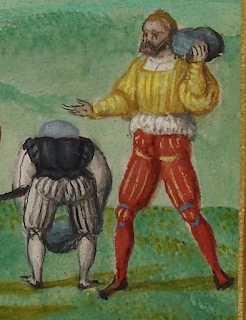 |
| Straight leg deadlift on the left, context suggests set-up for stone throw |
Still a good exercise choice.
Single-arm Press
Very good exercise. Sport specific by being upright and unilateral. This is a routine thing for me to include with my clients currently.
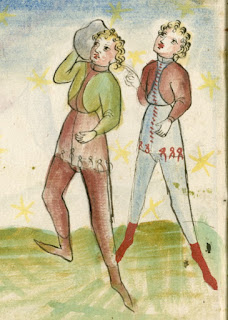 |
| Positioned for a single arm press |
Zercher Squat
Best squat you can do with the equipment. But it illustrates one of the key limitations of using the period style of equipment - weight progression is limited by the arms, so the legs just don’t get as much as they could.
A modern front squat permits maxing out the legs instead of the arms being the limiter.
Deadlift
Eventually, while doing the Zercher squats they reach a point where it’s hard to keep the weight off the ground and they switch to doing an Atlas stone style deadlift. Again, good exercise selection. Equipment limitations are noteworthy tho.
Pullup
Good exercise of course. But also not accessible for someone who doesn’t start with the strength-to-weight ratio necessary to do a pullup. Period equipment would make this a hard problem to solve, since the only strategy would be to do negatives.
Inverted rows are within the ability of the time, but hard to progress just by finding branches of the correct height.
This then is an area that makes modern equipment shine. Substitute/combine this with DB and BB rows and you’ve got your pulling motions covered.
Javelin Throwing
I LOVE EVERYTHING ABOUT THIS
I have wanted to incorporate javelin throwing into my regime ever since I learned it was a period exercise many years ago. But it’s hard to do while living in a city, in an apartment with no yard. Sigh.
But I get a similar stimulus from doing medicine ball throws. Light weight, high velocity, can be adjusted for movement specificity.
Stone Throwing
Also great! Same trouble as the javelin tho, but easier to overcome. I throw sandbells for this instead.
Clearly about to throw the stone
Long/Broad Jump
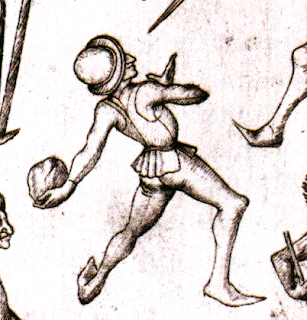
Talaga calls this a long jump. English language usage would call it a broad jump - the long jump involves a running start. Also a great exercise. Normal thing for me to include in my clients’ programs. Altho I prefer the box jump because it’s easier on the knees and allows for clear progression and tracking.
What’s Missing?
Really, not much besides the pulling exercise limitation.
We have all the basic categories covered:
Lifting
Squatting
Unilateral leg exercises
Pushing
Pulling
Anti-rotation/oblique abdominal exercises
Explosive exercises
Those are the categories I look to include in each exercise plan.
Conclusion
The other sort of limitation with this equipment is limited options for progression. And I suspect that the idea of a clear progression scheme may be missing from historical sources as well. At least based on the written sources that I am familiar with - that some folks in the era had an oral tradition of a progression scheme is of course possible.
I think this was cool PhD work, a cool idea and an informative video. It’s an interesting way to think about one’s modern training program as well. Have fun with this.

